







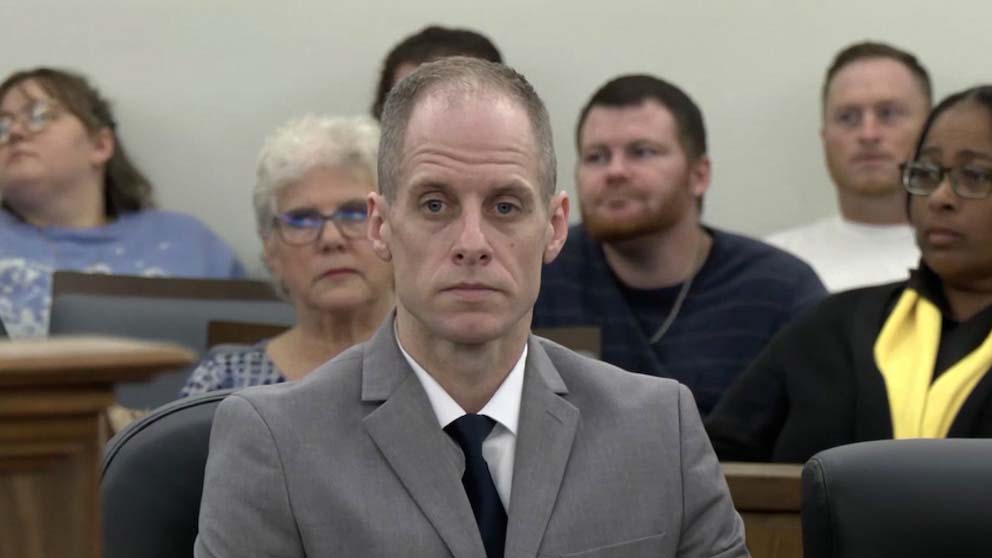
(NEW YORK) -- A verdict has been reached in the murder trial of an Ohio man accused of fatally shooting his wife, who had called 911 to report that an intruder broke into their home and killed the mother of two.
Caleb Flynn, 40, who once appeared as a contestant on "American Idol" in 2013, was charged with aggravated murder, murder, felonious assault and tampering with evidence in connection with the death of his wife, 37-year-old Ashley Flynn. He has pleaded not guilty.
The jury deliberated for nearly 2 1/2 hours before reaching a verdict Tuesday afternoon. The verdict has not yet been announced.
The former pastor called 911 early on Feb. 16 to report that his wife had been shot by an intruder at their home in Tipp City, north of Dayton. He was arrested three days later.
Prosecutors alleged that Caleb Flynn "executed" his wife by shooting her twice in the back of the head in bed so that he could be with his mistress and manipulated the crime scene to make it seem as if an intruder had broken in through the garage.
Miami County Assistant Prosecutor Matthew Joseph pointed to evidence including the physical scene, 911 call, text messages between Caleb Flynn and his mistress discussing the end of his marriage and digital records from the night of the shooting, which he argued "leads straight to the defendant."
"The evidence showed that being the victim would allow the defendant to keep his lucrative job working for Ashley's family business, he would benefit from Ashley's life insurance, and he could keep his position as a working worship leader with zero impact to his reputation within the church," Joseph said during closing arguments Tuesday in the Miami County courtroom. "The evidence does not tell the story of an intruder."
Joseph argued that key details in Caleb Flynn's recounting of what happened that night changed, and at the time when he told investigators he was sleeping before being woken up by gunshots, "his devices say he was awake and moving."
No gun has been found in the shooting, though Joseph told jurors that the recovery of the gun is not an element the state has to prove.
"But you heard the defendant kept a 9mm handgun in his truck console. His truck was parked in the garage. That console was up before law enforcement arrived and the gun was missing," Joseph said. "You heard that Ashley was shot twice in her head with 9mm bullets."
Defense attorney Patrick Mulligan argued during his closing that the state's evidence is circumstantial, and that the only thing prosecutors proved was that Caleb Flynn was having an affair.
"Connecting a couple of meaningless dots doesn't solve the case," Mulligan told jurors.
Mulligan said Caleb Flynn voluntarily spoke with detectives three times when he "didn't have to," consented to a search of his home and phone and voluntarily gave his fingerprints.
"He wanted to figure out who shot Ashley," Mulligan said.
On rebuttal, Miami County prosecuting attorney Paul Watkins urged jurors to use "common sense" and argued that the "evidence is clear" that Caleb Flynn is guilty.
The evidence in the case did not begin with the two gunshots, but months earlier, he argued, citing text messages between the defendant and his mistress, Alleigha Botner.
"The defendant, he had Alleigha, and he wanted out of his marriage," Watkins said. "The evidence shows that his feelings toward Ashley went far beyond simply wanting a divorce. He hated her."
Watkins said the language in the more than 100,000 messages Caleb Flynn and his mistress had sent each other "escalated" in months before the shooting while recounting some of the texts, including one from the defendant that said, "I want my girls full time in a life with you, but I can't have both. So I weigh the options, and I choose you."
"Not just hours before Ashley's execution, the defendant wrote this: 'Actions will come tomorrow. I'll never not be scared to do this, as I never want to hurt my daughters. That will always be there. But this month away from you has terrified me beyond belief,'" Watkins said, continuing to read the message. "'I know I can't live without you, and so again, if this gives me a 1% chance to spend my life with you, it's the 100% right decision. I choose you. I'm free.'"
"We are not here only because of someone's words," Watkins told jurors. "We are here because the defendant put actions to those words. The defendant made decisions."
Twenty days before Ashley Flynn was killed, Watkins said Caleb Flynn removed security cameras that had been in his home for years, including one that would have captured an intruder coming in from the garage. The day of the shooting, Watkins said the evidence shows that the defendant was also deleting apps off his phone and trying to delete his messages.
"In the hours after Ashley was murdered, the defendant was not mourning the death of his wife. He was whispering to his mistress, 'It didn't happen the way we thought it would,'" Watkins said. "I am confident after you deliberate, your verdict will tell the world this case did not end the way the defendant thought it would. The defendant wanted a new life. He wanted Ashley out of their life, and he didn't want to face the consequences of making the choice to pursue divorce."
Caleb Flynn could be seen crying throughout the closing arguments. He did not testify during the trial and the defense called no witnesses.
He denied killing his spouse in an interview with police days after the deadly shooting, according to video shown during the trial.
His former mistress testified for the state during the trial, reading from some of the more than 100,000 messages they exchanged over her two days of testimony.
"If I could literally kill her and not go to hell, I would do it in a heartbeat," Caleb Flynn said in one message from May 2025, Botner testified.
Copyright © 2026, ABC Audio. All rights reserved.